Verbal Reasoning Tests
Practice tests, solutions, and tips to help you pass employers' verbal reasoning tests.


Practice tests, solutions, and tips to help you pass employers' verbal reasoning tests.
Updated:
Have you been asked to take a verbal reasoning test but not sure on what to expect? Need to boost your test performance score?
Our experts have all the advice and practice tests you need to prepare for your test. The practice tests on AssessmentDay simulate the tests used by employers, so read through this guide and take some of our example questions to become familiar with the industry-standard style and layout.
A verbal reasoning test is used to assess your ability to understand and comprehend written passages. They are designed to measure your verbal comprehension, reasoning and logic, all through your understanding of language. Some people when reading a statement jump to conclusions or misinterpret information - this is what the test will be able to find out about you.
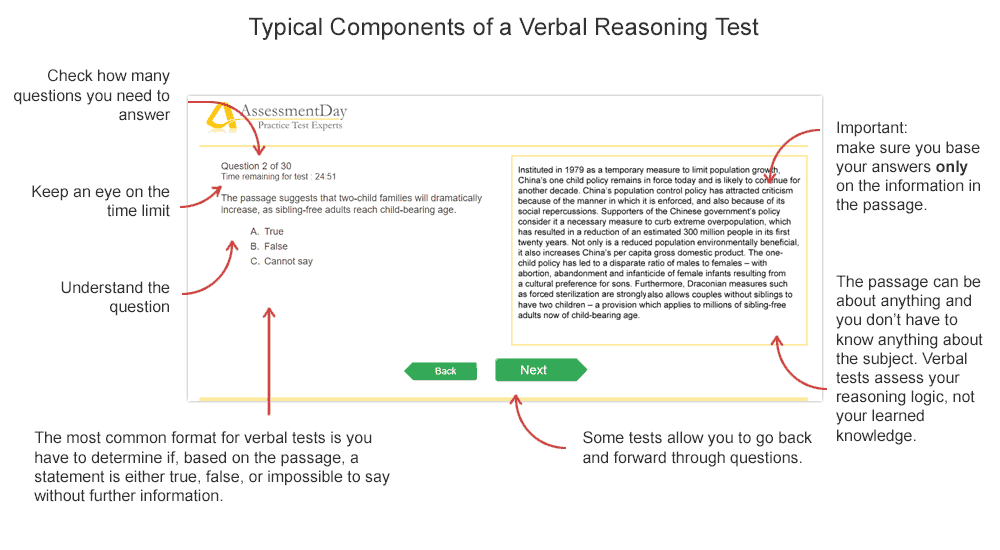
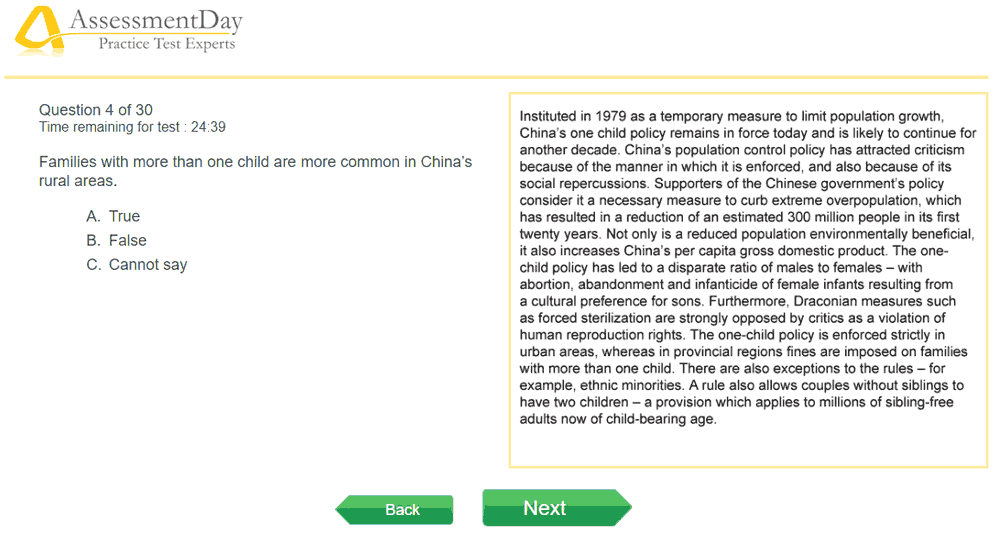
Verbal reasoning tests usually take the form of a written passage followed by a series of questions with possible True, False or Cannot Say responses. It is important you know and appreciate the meaning of each response if you are to score highly.
The best way to perform your best in a psychometric test is to be familiar with the test format and know what to expect. Practice is the best way to maximise your chances of test success.
Take a look at the following images to see the format of a typical verbal reasoning question:
Verbal Reasoning tests are used because they are better at predicting candidates' job performance than interviews, CVs and other traditional methods of selection. Employers use your verbal reasoning score, together with other selection factors such as interview performance, to help them decide which candidate is most suitable for the role.
Employers who use verbal reasoning tests are able to determine your skill level when dealing with language. This is a core skill in any working environment making verbal reasoning tests extremely popular, even for roles which are not immediately thought of as requiring strong verbal skills.
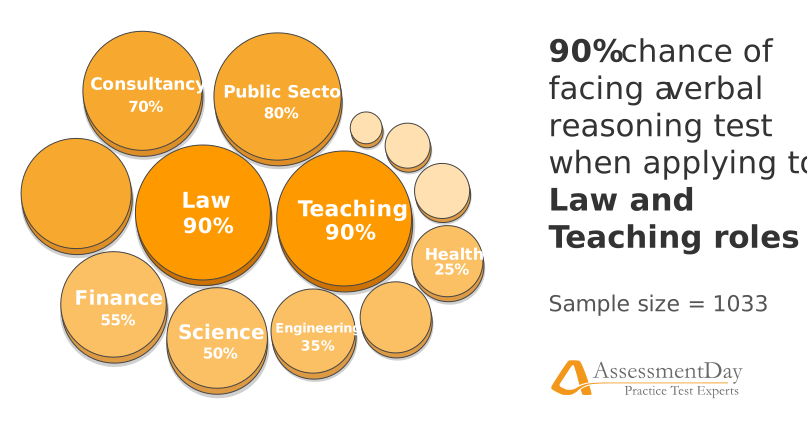
We conducted a study to find out which job sectors feature verbal reasoning tests most prevalently - our results showed that 90% of job applications for teaching and law roles required a verbal reasoning test. You can find our results below:
We have created a two-part verbal reasoning tutorial, in which we go through some verbal reasoning questions. This tutorial is designed to help you understand the format and process of a question.
The following video is part one of that tutorial:
This free numerical reasoning test contains 9 questions and has a time limit of 10 minutes. This test is rated as medium and is about the same difficulty as real numerical tests graduate employers use.
This free numerical reasoning test contains 9 questions and has a time limit of 10 minutes. This test is rated as medium and is about the same difficulty as real numerical tests graduate employers use.
When you are invited by an employer to take any reasoning test, try asking which test publisher they are using. You can then go to that test publisher's website to get more information and possibly example test questions. Some HR staff are surprisingly helpful with this. If it's an online test, it may mention somewhere in the emails or on the employer's website which test publishers they use.
Once you've found what test publisher is being used you can start doing research into the style of that particular test. Here are the most popular test publishers for verbal reasoning tests:
Through practice you will develop your own technique for answering aptitude test questions to the best of your ability. Many people have their own preference for how they like to answer verbal questions, and you may wish to switch your technique depending on whether you are running out of time.

It will often come down to just one or two sentences within the passage which will contain the relevant information to answer the question.
Get a good night's sleep before your test so that you stay focused during your real test. It's tempting to treat an online test less seriously, but be sure you are focused and alert. If it's at an assessment centre then arrive in plenty of time so that when you sit down to take your test you are calm and collected.
Make sure you understand the instructions. If your test is at an assessment centre the test administrator will explain the instructions and you will have the opportunity to ask questions. You usually get to go through a couple of example questions before the test begins for real. You will not be allowed to ask questions once the test has started, so make sure you take this opportunity to understand the test.
Are you comfortable? Is your desk wobbly? Are you distracted by noise from the next room? Make sure you raise any problems before the test starts with the test administrator, or eliminate the problems if you are at home.
Have an idea of how much time to allow yourself for each question and know when to move on. Concentration is essential, especially when every second counts. Don't let yourself get distracted by other test takers, this will slow you down.
Don't guess. The administrator probably won't tell you if negative marking is being used but rest assured it rarely is in the verbal reasoning tests used by employers. Instead of guessing outright, often it is possible to eliminate one of the possible three answers, thus reducing your options down to two. Beware some tests do have mechanisms for detecting random guessing, and this won't look good when the employer sees that you're a slap-dash risk taker. So don't be tempted to quickly guess the last questions just before the time runs out.
Base your answers on only the information contained in the passage. This is crucial, and if you don't do this you will probably get a lot of the questions wrong. Verbal reasoning tests are not tests of what you know, they are tests of how well you understand written information.
Focus on the next test. Employers use a whole series of tests, interviews and assessments to select candidates. The results are used in the whole; it is not the case that a poor result in one test instantly removes you from the running. If you don't think you did particularly well in one test, try not to let this affect your performance in another test.
It is becoming ever more important for candidates to receive feedback on their performance so they know how they can improve for future assessments.Goldman Sachs Recruiter
Ask for feedback. Not all employers have the time or resource to offer this but it's worth asking. If you know how you performed, this feedback can help you better prepare for that aspect next time.
The following video is part two of our two part verbal reasoning tutorial. If you still require extra information about verbal reasoning tests then check out verbal reasoning test tutorial and tips.