Verbal Reasoning Tests
Practice tests, solutions, and tips to help you pass employers' verbal reasoning tests.

Updated:
Have you been asked to take a verbal reasoning test but not sure on what to expect? Need to boost your test performance score?
Our experts have all the advice and practice tests you need to prepare for your test. The practice tests on AssessmentDay simulate the tests used by employers, so read through this guide and take some of our example questions to become familiar with the industry-standard style and layout.
Page contents:
Jump to:Looking to hire?
We recommend Test Partnership for companies seeking reliable hiring tests.

What is a verbal reasoning test?
A verbal reasoning test is used to assess your ability to understand and comprehend written passages. They are designed to measure your verbal comprehension, reasoning and logic, all through your understanding of language. Some people when reading a statement jump to conclusions or misinterpret information - this is what the test will be able to find out about you.
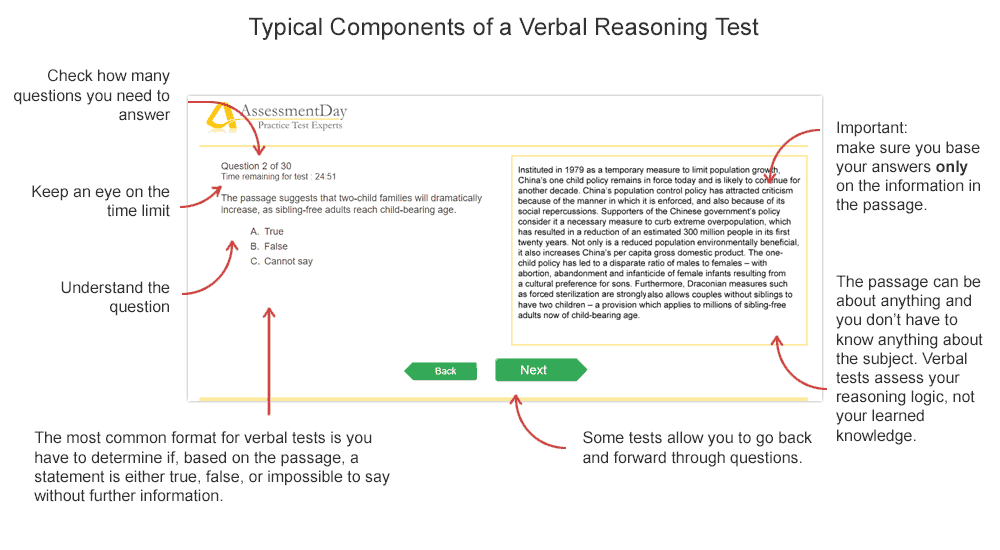
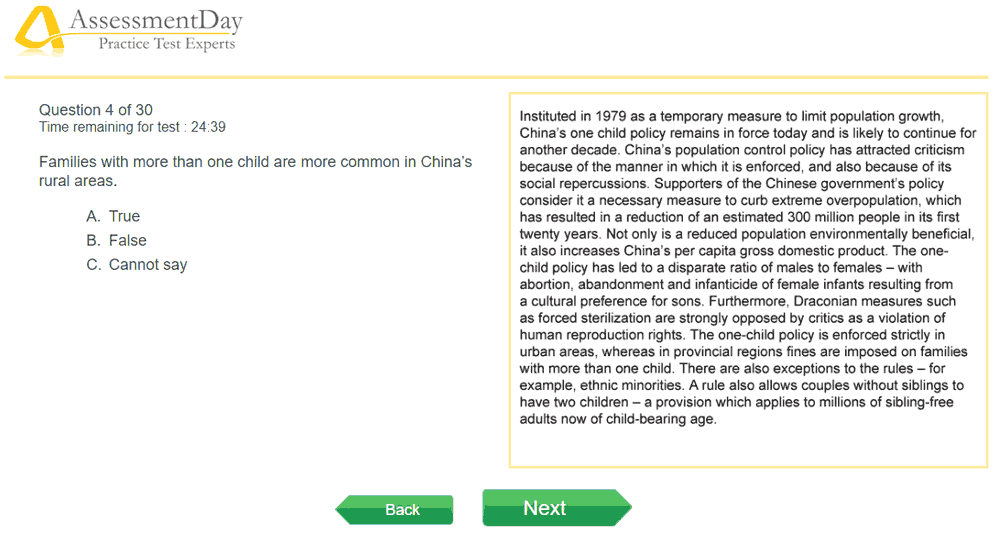
Verbal reasoning tests usually take the form of a written passage followed by a series of questions with possible True, False or Cannot Say responses. It is important you know and appreciate the meaning of each response if you are to score highly.
- True - The statement follows logically given the information contained within the passage.
- False - The statement cannot logically follow given the information contained within the passage.
- Cannot Say - It is not possible to determine given the information contained within the passage alone; i.e. more information would be required to say for certain.
The best way to perform your best in a psychometric test is to be familiar with the test format and know what to expect. Practice is the best way to maximise your chances of test success.
What is an example of verbal reasoning?
Take a look at the following images to see the format of a typical verbal reasoning question:
Why do employers use verbal reasoning tests?
Verbal Reasoning tests are used because they are better at predicting candidates' job performance than interviews, CVs and other traditional methods of selection. Employers use your verbal reasoning score, together with other selection factors such as interview performance, to help them decide which candidate is most suitable for the role.
Employers who use verbal reasoning tests are able to determine your skill level when dealing with language. This is a core skill in any working environment making verbal reasoning tests extremely popular, even for roles which are not immediately thought of as requiring strong verbal skills.
Survey results
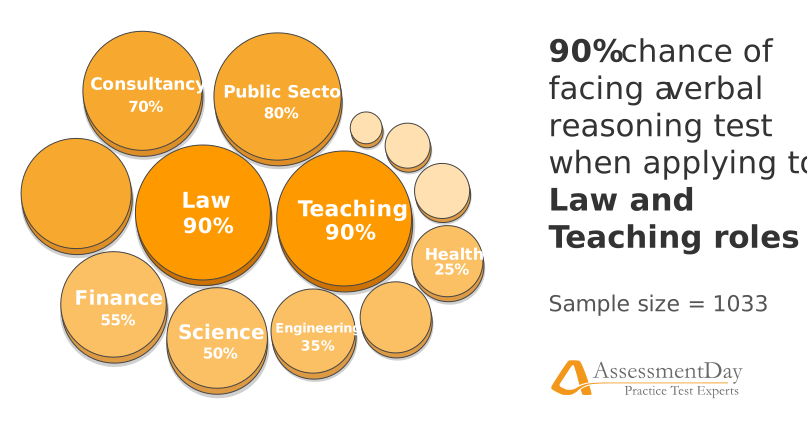
We conducted a study to find out which job sectors feature verbal reasoning tests most prevalently - our results showed that 90% of job applications for teaching and law roles required a verbal reasoning test. You can find our results below:
Verbal reasoning tutorial - part 1
We have created a two-part verbal reasoning tutorial, in which we go through some verbal reasoning questions. This tutorial is designed to help you understand the format and process of a question.
The following video is part one of that tutorial:
Free practice verbal reasoning test
Free Verbal Reasoning Test
FreeThis free shortened verbal reasoning test contains 9 questions and has a time limit of 10 minutes. This test is rated as medium and is about the same difficulty as real verbal tests graduate employers use.
Free Verbal Reasoning Test
Try here a new verbal reasoning test directly from Test Partnership!
Verbal Reasoning Test 3
Premium- 30 questions
- 19 mins
Verbal Reasoning Test 4
PremiumVerbal Reasoning Test 5
PremiumVerbal Reasoning Test 6
PremiumThe most common verbal reasoning tests used by employers
When you are invited by an employer to take any reasoning test, try asking which test publisher they are using. You can then go to that test publisher's website to get more information and possibly example test questions. Some HR staff are surprisingly helpful with this. If it's an online test, it may mention somewhere in the emails or on the employer's website which test publishers they use.
Once you've found what test publisher is being used you can start doing research into the style of that particular test. Here are the most popular test publishers for verbal reasoning tests:
- 1. SHL Verify Ability Tests - SHL are the most widely used test publisher so you are likely to come across their tests during your application process. Their verbal tests have a time limit of between 17 and 19 minutes so you will need to work quickly and accurately to perform well.
- 2. SHL VMG - This series of tests belong to a test battery known as MGIB (Managerial and Graduate Item Bank). The questions on the test are selected from an item bank, with each item chosen based on its difficulty level, and its content varying in each test to prevent candidates sharing answers. The VMG takes 12 minutes to complete and contains 24 questions.
- 3. Talent Q Elements Verbal Ability - The big difference with these tests is that they are adaptive. That is to say the difficulty of each question is automatically determined by your performance in the previous question. So the questions become more difficult as you progress in order to quickly find your level of ability. A typical time limit is 90 seconds for questions with a fresh set of information and 75 seconds per question after that. Also the number of multiple choice options is a lot greater compared with what you might be used to from SHL, making it more difficult to make a best guess.
- 4. Test Partnership Verbal Reasoning - These tests consist of 20 questions with a time limit of 15 minutes. They are adaptive and follow the 'definitely true, probably true, insufficient information, probably false, definitely false' format
- 5. Cubiks Verbal Reasoning for Business - Designed to test candidates' business-orientated verbal reasoning skills. You usually get less than a minute per question.
- 6. Kenexa/PSL Advance Verbal Reasoning Tests - This series of tests contains two levels: general ability and graduate/managerial. The general ability test comprises 24 questions and an 18 minute time limit. The graduate and managerial test comprises 32 questions and a 25 minute time limit.
- 7. Kenexa/PSL Infinity Verbal Reasoning Tests - Unlike other verbal reasoning tests, these have a number of fixed comparable tests. The test takes 20 minutes to complete and is comprised of 24 questions.
- 8. Cappfinity Verbal Reasoning Test - a unique mixture of verbal questions. There are drag-and-drop, drop down passage, edit passage, ranking, and multiple choice style questions. With 15 questions but no time limit, you have lots of time for each question. But the diversity of question styles can make this test challenging.
- 9. Bespoke verbal reasoning tests - Some larger companies prefer to have their own tests created which closely match the situations candidates can expect in the job role. These tests vary slightly in style and time limit but you will still benefit from practising the industry-standard tests such as those on AssessmentDay.
Start practising quality tests with a free account
Practice makes perfect
- Learn from detailed solutions
- Track your progress
What's the best technique for verbal tests?
Through practice you will develop your own technique for answering aptitude test questions to the best of your ability. Many people have their own preference for how they like to answer verbal questions, and you may wish to switch your technique depending on whether you are running out of time.
PRO TIP!
There is a general technique which most people find useful to follow:
- Read the entire passage through once, then each of the questions in turn.
- Read the first statement and refer back to the relevant part of the passage to carefully consider if the statement is true, false, or impossible to determine without further information.
It will often come down to just one or two sentences within the passage which will contain the relevant information to answer the question.
Advice for before your test
Get a good night's sleep before your test so that you stay focused during your real test. It's tempting to treat an online test less seriously, but be sure you are focused and alert. If it's at an assessment centre then arrive in plenty of time so that when you sit down to take your test you are calm and collected.
Make sure you understand the instructions. If your test is at an assessment centre the test administrator will explain the instructions and you will have the opportunity to ask questions. You usually get to go through a couple of example questions before the test begins for real. You will not be allowed to ask questions once the test has started, so make sure you take this opportunity to understand the test.
Are you comfortable? Is your desk wobbly? Are you distracted by noise from the next room? Make sure you raise any problems before the test starts with the test administrator, or eliminate the problems if you are at home.
Advice for during your test
Have an idea of how much time to allow yourself for each question and know when to move on. Concentration is essential, especially when every second counts. Don't let yourself get distracted by other test takers, this will slow you down.
Don't guess. The administrator probably won't tell you if negative marking is being used but rest assured it rarely is in the verbal reasoning tests used by employers. Instead of guessing outright, often it is possible to eliminate one of the possible three answers, thus reducing your options down to two. Beware some tests do have mechanisms for detecting random guessing, and this won't look good when the employer sees that you're a slap-dash risk taker. So don't be tempted to quickly guess the last questions just before the time runs out.
PRO TIP!
Base your answers on only the information contained in the passage. This is crucial, and if you don't do this you will probably get a lot of the questions wrong. Verbal reasoning tests are not tests of what you know, they are tests of how well you understand written information.
Advice for after your test
Focus on the next test. Employers use a whole series of tests, interviews and assessments to select candidates. The results are used in the whole; it is not the case that a poor result in one test instantly removes you from the running. If you don't think you did particularly well in one test, try not to let this affect your performance in another test.
It is becoming ever more important for candidates to receive feedback on their performance so they know how they can improve for future assessments.Goldman Sachs Recruiter
Ask for feedback. Not all employers have the time or resource to offer this but it's worth asking. If you know how you performed, this feedback can help you better prepare for that aspect next time.
Top tips for verbal reasoning
The following video is part two of our two part verbal reasoning tutorial. If you still require extra information about verbal reasoning tests then check out verbal reasoning test tutorial and tips.